


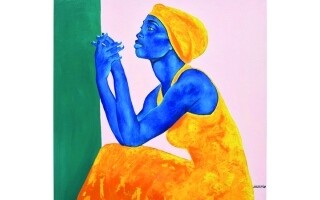
In the northern region of Ghana, the color blue symbolizes coral reefs. The artist Heva Aunli Iburu received recognition thanks to her inclusion in the 'Artemartis' group, founded by a group of Ghanaian artists under the leadership of Silas Djamado in 2018. According to Djamado, it all started with small exhibitions in the restaurants of Akra, then she moved to collaborating with well-known artistic institutions. Djamado emphasized that everyone in the Artemartis group faced challenges, standing before each artist, and rejoiced in each of their victories.
According to data from the United Nations Children's Fund (UNICEF), in Ghana, over two million girls are forced to marry, with one in five girls becoming wives or entering relationships before reaching the age of 18. Despite the declining rates of child marriages worldwide, in Ghana, this practice remains widespread.
Heva Aunli Iburu's paintings reflect the struggles she had to overcome in her childhood, including early marriage; she emphasizes that the primary reasons for child marriages are neglect and poverty. The artist was raised in a conservative family with three brothers. She was 12 when her mother was forced to marry someone significantly older. Initially, she was sent there for cooking and cleaning, but with support from her aunt, she managed to break free. Subsequently, while embracing creativity, Heva organized a solo exhibition in the capital of Ghana, Akra, under the title 'A beautiful operation does not make a beautiful bird.'
Heva, having learned to draw independently, began studying lessons on YouTube after leaving her administrator job at the age of 22. She also received training from a local artist. Her first series of works, 'Search for the Wall,' consisted of self-portraits. It was interesting for her to explore the concept of 'homeland,' as at that time she suffered from the burden of early marriage and feelings of loneliness. According to her, she was so overwhelmed that she could not share her experiences with anyone.
Upon returning from her travels in Tamale, in northern Ghana in 2023, Heva realized that 'the main reasons for child marriages are the mix of neglect and poverty.' She explains that many fathers force their daughters to marry because they lack resources. She is inspired by aspects of Ghanaian life that are often hidden or neglected. Heva portrays marginalized women, striving to capture the spirit of women in Western Africa, who often endure limiting stereotypes in society. One of the characteristic features of her work is the use of blue tones, symbolizing 'freedom from boundaries and control compared to boundless seas and oceans.'